Strange Echoes and Computer Visions

Digital Reflections of Three Lynn Hershman Leeson Films · Project lead with Eva Jacobus, Anthony Inga; PIRL collaborators · 2018

Immersive media environment; multichannel projection, ambient soundscape, telephonic interface.

In Strange Echoes and Computer Visions (2018), which I led with UTD’s Public Interactives Research Lab (PIRL), we produced an immersive environment using the films of Lynn Hershman Leeson as the raw material, data that informed generative machine-learning visualizations.

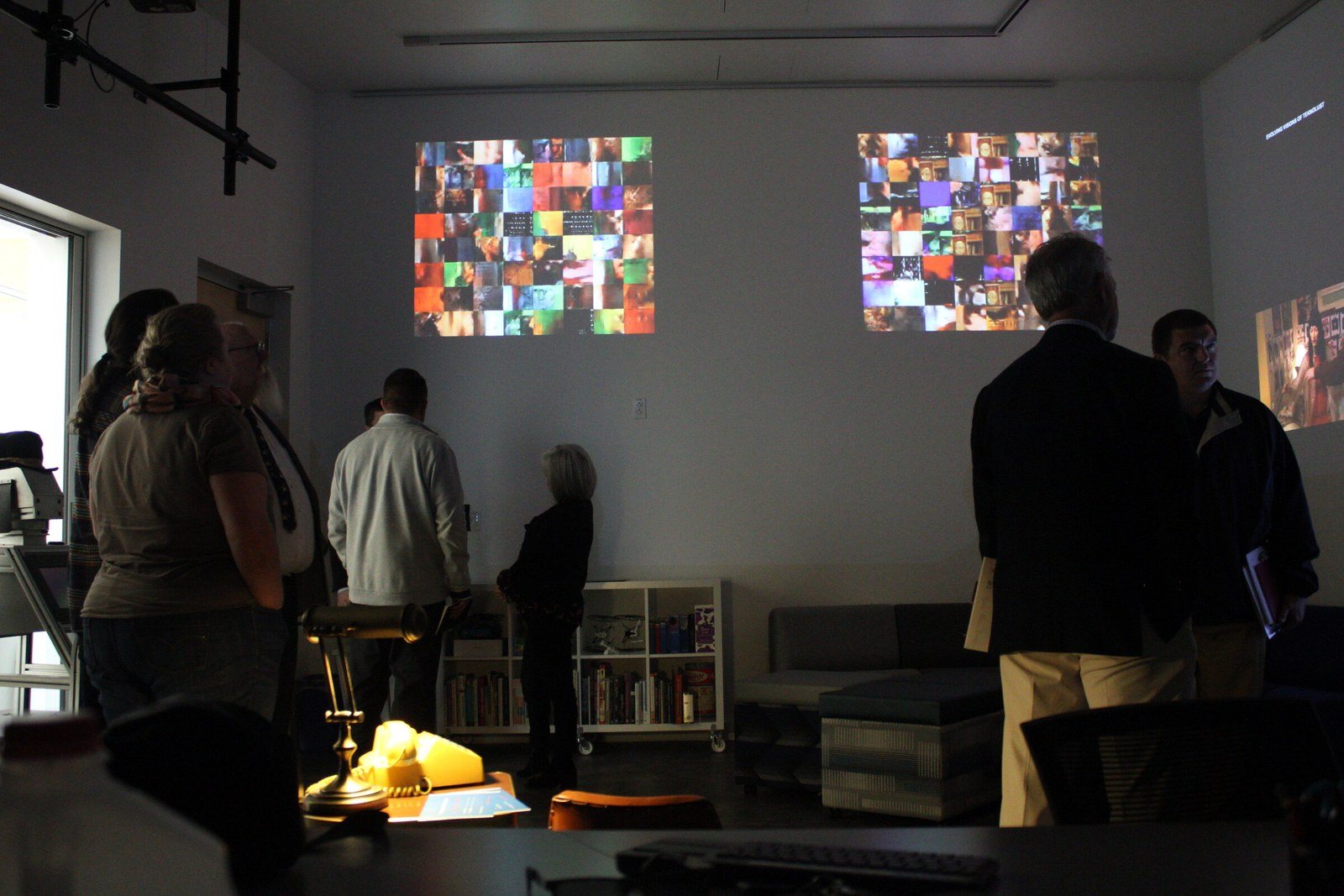
Visitors standing in a dark room before two walls of projected video mosaics; a desk lamp lights the yellow telephone station at lower left
Visitors and the video walls; the telephone station at lower left. ATEC, UT Dallas, October 19, 2018.

What it is

A remix and reprocessing of three Lynn Hershman Leeson films (Conceiving Ada, Strange Culture and Teknolust). Reprocessed, remixed assets transformed films into archives and corpuses of data; a meditation, in dialogue with the work of the artist, on computer vision, surveillance, and electronic identity.

What was built, how it works

An interactive media environment featuring immersive video walls running generative machine-learning visualizations, an ambient soundscape and an experiential work of telephonic art. On the left wall, the DCGAN images; on the right, stills drawn from the films stochastically to serve as ground and referent.

Role

Project lead, with PIRL

With

Eva Jacobus and Anthony Inga; David N. Wilson, Grace Brady, Abby Mancini, Caroline Trotter, Khadeeja Zulqarnain

Materials

Two projectors, a Mac mini, five speakers, a Western Electric 2500 touchtone phone, a telephone desk, a desk lamp

Models

DCGAN; DeepDream (“Inceptionism”)

Shown

Lynn Hershman Leeson Artist-in-Residence celebration, ATEC, UT Dallas, October 19, 2018

From films to an environment

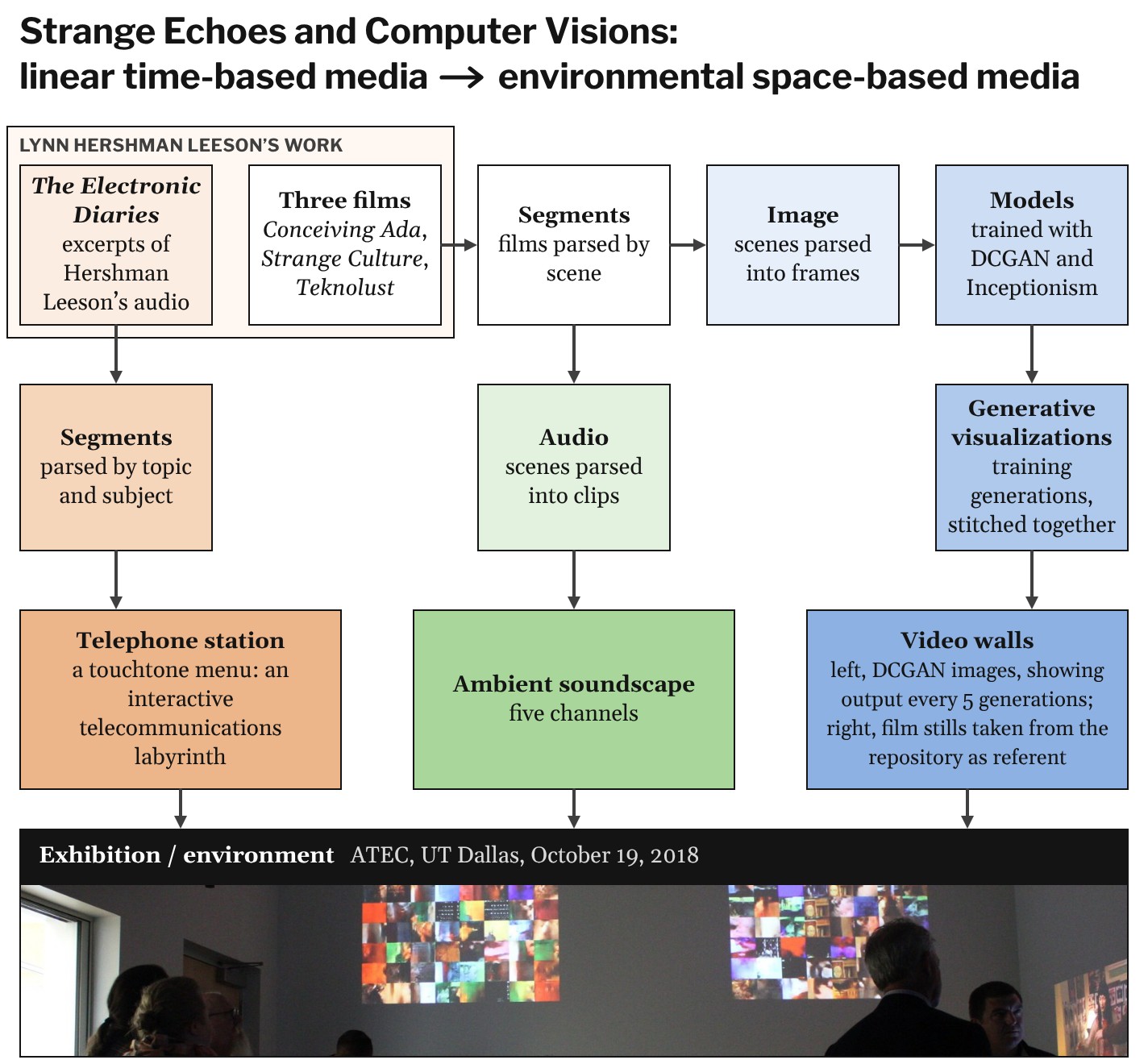
Diagram. Lynn Hershman Leeson's work: The Electronic Diaries, excerpts of her audio, and three films, Conceiving Ada, Strange Culture and Teknolust. The diaries are parsed by topic and subject into segments that feed the telephone station, a touchtone menu: an interactive telecommunications labyrinth. The films are parsed by scene into segments; scenes are parsed into frames, which train models with DCGAN and Inceptionism; the training generations are stitched together into generative visualizations for the video walls, with DCGAN images on the left, showing output every five generations, and film stills from the repository on the right as referent. Scenes are also parsed into audio clips for a five-channel ambient soundscape. The telephone station, soundscape and video walls together make the exhibition environment at ATEC, UT Dallas, October 19, 2018.
Linear time-based media into environmental space-based media. Tap or click the diagram to open it full size.
DCGAN samples trained on frames of Conceiving Ada, from noise toward faces and rooms. On the left wall, the training showed its output every five generations.

Discoveries

The project began by understanding the films structurally through a database cinema approach. A team of human editors applied their expertise to segmentation: marking a distinct scene, a distinct sequence within the scene; clips programmatically parsed, 24 frames per second, into folders of still images. In the training, we began to see patterns repeat themselves, which informed and modified how we understood the films: a proclivity towards close-ups and medium shots; a repeating figure of green, vector-like computational space; an impressionistic variety of data visualization, through ghosts, representative of how often certain imagery showed up in the original training data.

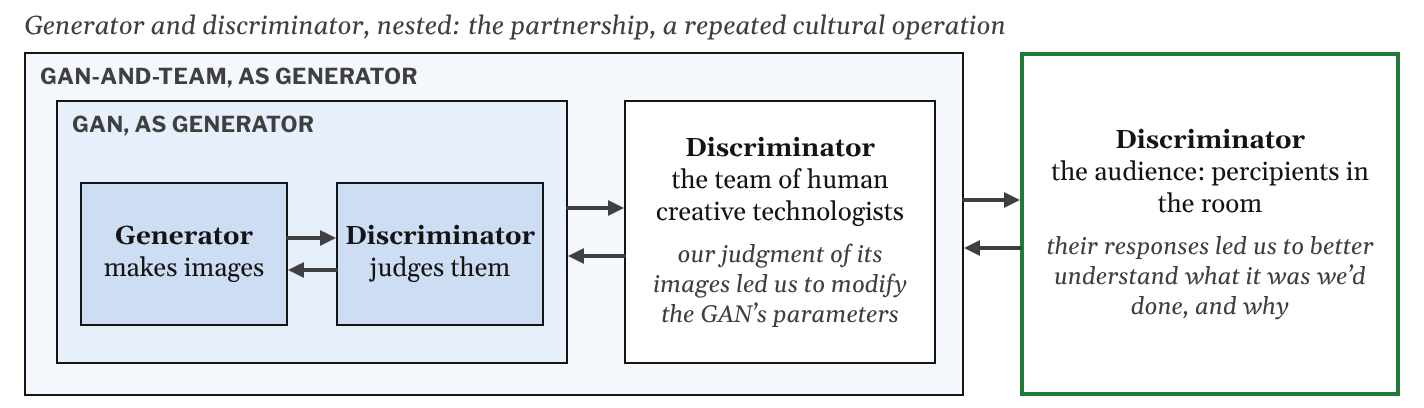
By showing the training as it elapsed, every five generations, we could see how it took shape, how latent space formed, how, from noise, signal can emerge between the generator and the discriminator. But there was not only the generator and the discriminator in the GAN; there was another layer. The discriminator-and-generator of the GAN became a generator, and the team of human creative technologists became, themselves, a kind of discriminator, applying modifications to the GAN; then the GAN-and-team became generator, and the audience, the percipients, became discriminator, giving feedback that further altered the operation: it is not uncommon to think of ML and the human as a partnership, but here we could see how that partnership cooperated with the larger cultural operation of interpretation and meaning-making.

Diagram. Generator and discriminator, nested. Inside the GAN, the generator makes images and the discriminator judges them. The GAN as a whole acts as a generator for a second discriminator, the team of human creative technologists, whose judgment of its images led them to modify the GAN's parameters. The GAN-and-team then acts as a generator for a third discriminator, the audience, percipients in the room, whose responses led the team to better understand what it was they had done, and why.
Generator and discriminator, nested: the partnership, a repeated cultural operation.

Because our work was imperfect, it was somewhat transparent; part of the environment was the ongoing conversation of how it was being generated; this became a platform to help visitors understand the capacities, the limitations, the aesthetic possibilities. In today’s models, such operations are routinely obscured and mystified, put out of reach.
The telephone station

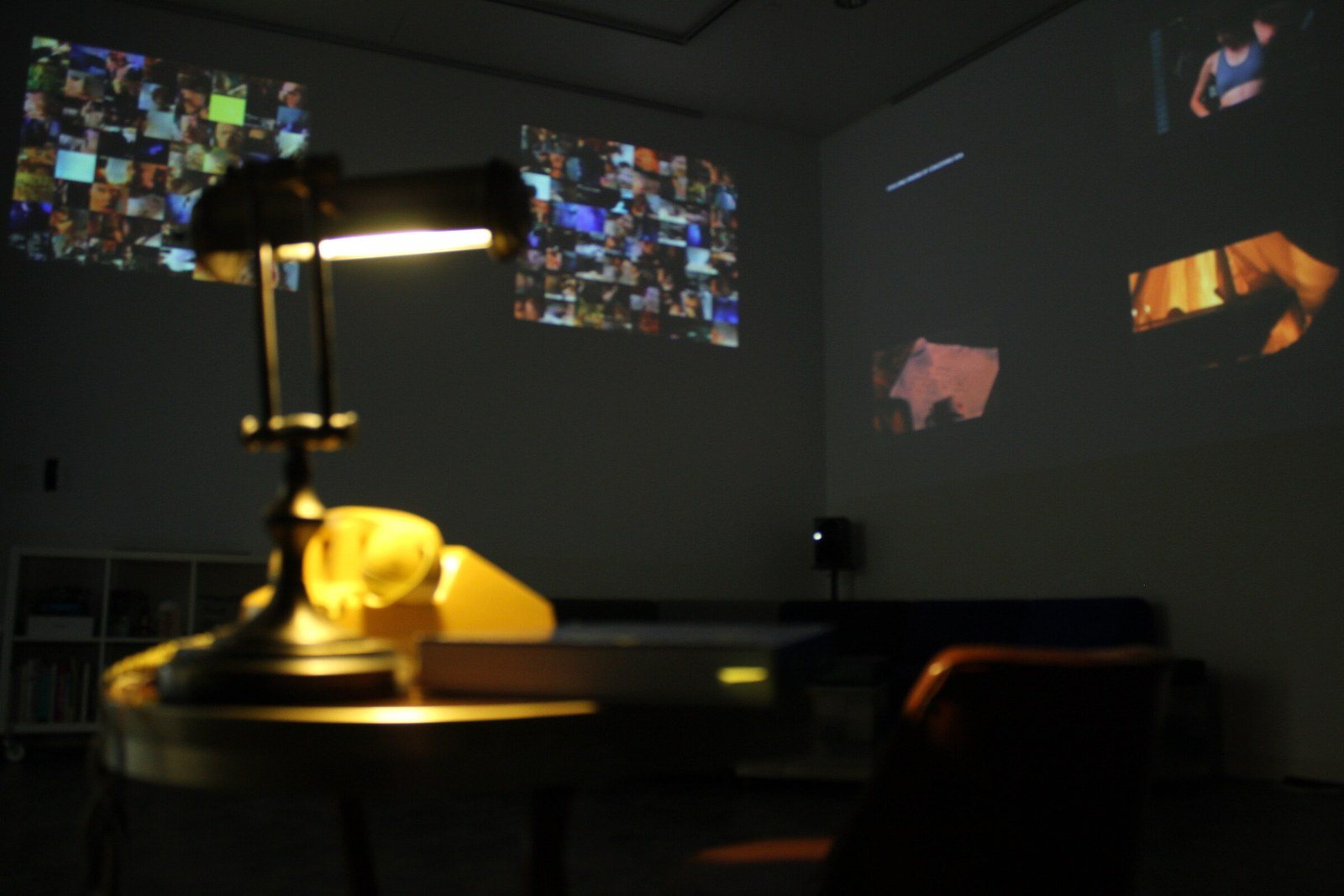
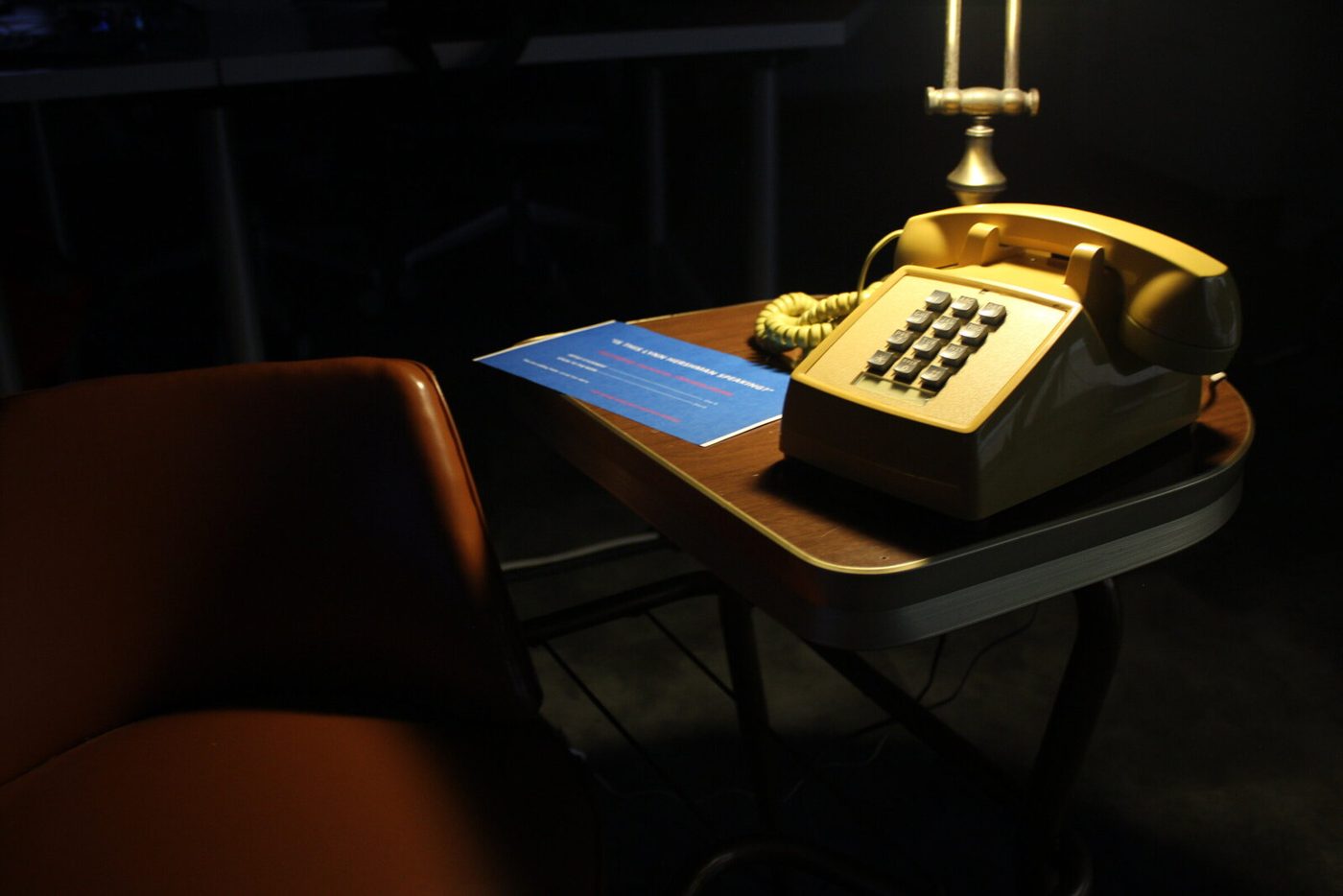
The lamp-lit yellow telephone station in the foreground, with the projected video walls glowing behind it Close view of the touchtone telephone on its desk beside a printed menu card
A touchtone menu: an interactive telecommunications labyrinth, built from excerpts of Hershman Leeson’s audio from The Electronic Diaries, parsed by topic and subject.

The station grew out of It’s For You →